
Film History: How the Hero’s Journey Shaped Cinema Today

The art of telling stories is a part of human nature. If we look back as far as human history goes, there were different forms of storytelling. The Lascaux Cave in France exhibits some of the earliest examples of human artistic expression, including storytelling. The Unicorn Tapestries, created between 1495 and 1505, exemplify the medieval art of storytelling. From Egyptian mythology to Star Wars, storytelling is in our nature, but what do all of these mythologies, art forms, and modern-day Cinema have in common? The Hero’s Journey.
Things to do:
- Subscribe to The Hollywood Insider’s YouTube Channel, by clicking here.
- Limited Time Offer – FREE Subscription to The Hollywood Insider
- Click here to read more on The Hollywood Insider’s vision, values and mission statement here – Media has the responsibility to better our world – The Hollywood Insider fully focuses on substance and meaningful entertainment, against gossip and scandal, by combining entertainment, education, and philanthropy.
Joseph Campbell
The concept of the Hero’s Journey was first established by Joseph Campbell. Campbell held a fascination with the similarities between catholicism and Native American mythology from an early age. This early observation of the parallels between two completely different sides of the religious spectrum would shape Campbell’s pursuit of mythologies as he grew further into life. In 1949, Campbell established his best-known work, ‘The Hero With A Thousand Faces’. This novel portrayed the theory that all storytelling, from the early humans to now, carries the same Hero’s Journey but with a different hero in every story. Each hero goes through three steps: The departure or leaving behind their ordinary world. Then, the initiation occurs when the hero enters the special world. And finally, the return home.
Consider a story like the tale of Icarus. This well-known Greek Myth shouldn’t carry a resemblance to a modern-day film such as Iron Man. Except, it does. Both Icarus and Iron Man take part in the Hero’s Journey. Christopher Vogel took Campbell’s three simple steps and broke them down into the 12 stages of the Hero’s Journey.
WATCH THE TRAILER of the Film and the Revolution: ‘Can I Go Home Now?’
The Children Around the World Continue to Ask the question
The 12 Stages Of The Hero’s Journey
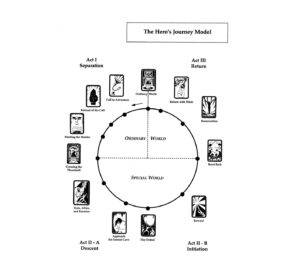 Christopher Vogel’s 12 Stages of the Hero’s Journey
Joseph Campbell may have started the theory of the Hero’s Journey, but Christopher Vogler established the 12 Stages of the Hero’s Journey in his textbook ‘The Writer’s Journey: MythicStructure For Writers’. Vogler’s textbook suggested that each of these mythical heroes took the same 12 steps in the Hero’s Journey. So, what are these steps?
Step one starts with the establishment of our hero’s ordinary world. This step sets up our hero, introducing who they are and what they believe in. It establishes their everyday life and what that looks like. In ‘Easy A,’ Olive Penderghast’s ordinary world sets her up to be a regular high schooler who feels unseen.
After the establishment of the ordinary world, our hero receives their call to adventure. In Easy A, this is the moment when Olive Penderghast lies to her best friend, Rhiannon, about sleeping with a college boy. The lie spreads around the school, and suddenly, Olive is the talk of the school.
After the call to adventure, our hero will refuse the call. The refusal of the call can often happen in the same scene. In ‘Easy A’, it is when Olive tries to tell Marianne that she made it. The refusal of the call never works, and our hero ends up going on the journey anyway.
At some point, our hero will meet their mentor. In ‘Easy A’, we meet Olive’s mentor after she gets detention. During detention, she reunites with an old friend, Brandon. Then our hero crosses the threshold. This is the point at which Olive really embraces the rumor version of herself and starts making deals with boys around the school.
Once our hero has crossed the threshold, they face trials. This stage is referred to as tests, allies, and enemies. The tests, allies, and enemies stage makes up a good portion of the story. Olive displays this stage in many scenes, but one of the most notable moments is when she forms an unlikely friendship with Marianne.
The next stage is when our hero hits rock bottom, the innermost cave. Our hero must confront aspects of themselves that they have tried to hide or may not have even realized existed. For Olive, this is the scene when she goes on a terrible date with Anson. At this point, Olive has started to believe the rumors herself. She has lost her best friend, and things only get rougher after the date with Anson, who was just trying to make a deal with Olive for sex.
Then comes the ordeal. In ‘Easy A’, this is the point when Lobster Todd admits how he truly feels about Olive. Olive then decides to come clean and reclaim her life, which leads us to the reward. For Olive, the reward is regaining her confidence.
After the reward, there is the road back. For Olive, this starts with the gym scene. Olive fully embraces the rumor one last time to grab everyone’s attention to reveal the truth. Then Olive faces the resurrection and the return with the elixir. This is the final scene of ‘Easy A’, when everyone finally knows the truth, and Olive and Todd ride off together.
Related article: – Want GUARANTEED SUCCESS? Remove these ten words from your vocabulary| Transform your life INSTANTLY
Related article: Reawakening The Legend: A Journey Through Star Wars’ Past to Shape its Future
How The Hero’s Journey Changed Cinema
In Cinema, the Hero’s Journey and its 12 stages are the standard for writing films. But it wasn’t always that way. The Hero’s Journey wasn’t popularized or even well-known in the film industry until after the release of ‘Star Wars’, later renamed ‘Star Wars: A New Hope’. George Lucas, the creator of the film, had used Joseph Campbell’s Hero’s Journey when writing the film.
After ‘Star Wars’ became a hit, the Hero’s Journey became more recognizable in Cinema. And before long, it became the industry standard. Without George Lucas and ‘Star Wars, film likely wouldn’t be the same. The Hero’s Journey provides a structure for writing film, making it easier for writers to understand the journey their heroes must undertake. Without it, the stories wouldn’t catch the audience’s attention in the same way.
Related article: EVOLUTION: Every Ryan Gosling Role From 1995 to 2020, All Performances Exceptionally Poignant
Related article: EVOLUTION: Every Henry Cavill Role From 2001 to 2021, All Performances Exceptionally Poignant
Related article: The Force And Personal Struggles: Understanding the Deeper Conflict In Star Wars
Conclusion
To sum it all up, throughout human history, we have told stories. The Hero’s Journey is a pattern that can be recognized throughout our history. The Hero’s Journey and the 12 Steps of the Hero’s Journey now serve as the blueprint to any modern-day film, making it easier to create masterpieces that audiences can relate to. Thanks to Joseph Campbell, Christopher Vogel, and George Lucas, Cinema continues to thrive.
By Sage Rhien
Click here to read The Hollywood Insider’s CEO Pritan Ambroase’s love letter to Cinema, TV and Media. An excerpt from the love letter: The Hollywood Insider’s CEO/editor-in-chief Pritan Ambroase affirms, “We have the space and time for all your stories, no matter who/what/where you are. Media/Cinema/TV have a responsibility to better the world and The Hollywood Insider will continue to do so. Talent, diversity and authenticity matter in Cinema/TV, media and storytelling. In fact, I reckon that we should announce “talent-diversity-authenticity-storytelling-Cinema-Oscars-Academy-Awards” as synonyms of each other. We show respect to talent and stories regardless of their skin color, race, gender, sexuality, religion, nationality, etc., thus allowing authenticity into this system just by something as simple as accepting and showing respect to the human species’ factual diversity. We become greater just by respecting and appreciating talent in all its shapes, sizes, and forms. Award winners, which includes nominees, must be chosen on the greatness of their talent ALONE.
I am sure I am speaking for a multitude of Cinema lovers all over the world when I speak of the following sentiments that this medium of art has blessed me with. Cinema taught me about our world, at times in English and at times through the beautiful one-inch bar of subtitles. I learned from the stories in the global movies that we are all alike across all borders. Remember that one of the best symbols of many great civilizations and their prosperity has been the art they have left behind. This art can be in the form of paintings, sculptures, architecture, writings, inventions, etc. For our modern society, Cinema happens to be one of them. Cinema is more than just a form of entertainment, it is an integral part of society. I love the world uniting, be it for Cinema, TV, media, art, fashion, sport, etc. Please keep this going full speed.”
More Interesting Stories From The Hollywood Insider
– Want GUARANTEED SUCCESS? Remove these ten words from your vocabulary| Transform your life INSTANTLY
– A Tribute to Martin Scorsese: A Complete Analysis of the Life and Career of the Man Who Lives and Breathes Cinema
– Do you know the hidden messages in ‘Call Me By Your Name’? Find out behind the scenes facts in the full commentary and In-depth analysis of the cinematic masterpiece
– A Tribute To The Academy Awards: All Best Actor/Actress Speeches From The Beginning Of Oscars 1929-2019 | From Rami Malek, Leonardo DiCaprio To Denzel Washington, Halle Berry & Beyond | From Olivia Colman, Meryl Streep To Bette Davis & Beyond
– In the 32nd Year Of His Career, Keanu Reeves’ Face Continues To Reign After Launching Movies Earning Over $4.3 Billion In Total – “John Wick”, “Toy Story 4”, “Matrix”, And Many More
Author
You might also like…







Sage is a writer at heart, discovering her passion for writing at the young age of 12. She hopes to publish a few novels someday and write movies. She is currently pursuing a Bachelor’s in Film and Television Writing at the Los Angeles Film School. Sage aligns with the Hollywood Insider belief that active and engaging content is an excellent tool for bringing people together. And by writing for Hollywood Insider, she can use her voice to encourage other creators to persevere and shed light on perspectives that may otherwise go unnoticed.
Sage is a writer at heart, discovering her passion for writing at the young age of 12. She hopes to publish a few novels someday and write movies. She is currently pursuing a Bachelor’s in Film and Television Writing at the Los Angeles Film School. Sage aligns with the Hollywood Insider belief that active and engaging content is an excellent tool for bringing people together. And by writing for Hollywood Insider, she can use her voice to encourage other creators to persevere and shed light on perspectives that may otherwise go unnoticed.